 Comply Launches Financial Services' First Agentic Compliance Platform MCP Server, Enabling Teams to Build Custom AI Agents Without Developers

Here’s a conversation happening in compliance departments everywhere: “Do we allow texting with clients?”
Some firms answer with a hard no and update their policies accordingly. Others say yes and immediately ask: “If we do, how do we actually supervise it?”
Here’s what both groups need to know: the regulatory answer is the same either way. If you prohibit texting, you need to be able to demonstrate that prohibition is actually being enforced – which means monitoring for off-channel use. If you allow it, you need operational controls that prove ongoing supervision.
Written policy alone doesn’t satisfy the SEC. The operational reality? That’s where it gets complicated.
What Regulators Mean When They Say “Books and Records”
When examiners reference books and records, they’re really asking: can you evidence what happened across every channel your firm uses to conduct advisory business?
Rule 204-2 requires you to maintain true, accurate, and current books and records – including originals of written communications relating to recommendations, advice, and the placing or execution of orders. The SEC has been clear: these obligations extend to electronic communications regardless of the platform. Email, social posts, instant messages, texts – if advisory business happens there, the record needs to be preserved.
The Enforcement Reality
The regulatory focus on off-channel communications isn’t theoretical. Earlier this year, FINRA fined a firm $750,000 for failing to preserve business-related text messages. Representatives were texting clients about securities transactions on personal devices. Those messages weren’t captured, retained, or reviewed.
When the firm couldn’t produce complete records of business communications, they also couldn’t demonstrate supervisory oversight of those interactions. It’s a pattern examiners see repeatedly: when communications aren’t archived, supervision can’t be evidenced. Recordkeeping deficiencies continue to be among the most common exam findings.
Policy Without Proof Doesn’t Work
Some firms ban texting outright. Others permit it and rely on written policies backed by annual attestations from reps.
Here’s what examiners actually look for: evidence that your policies function in practice. If you prohibit texting, you need to show active monitoring for off-channel use and documented enforcement when violations occur. That means being able to demonstrate you’re actually checking not just hoping reps comply. If you allow it, you need operational controls that prove ongoing supervision.
Practical supervision looks similar regardless of your policy stance: reviewing email for references to text follow-ups, spot-checking devices or conducting surveillance, reinforcing policies through regular training, and documenting supervisory review and escalation when issues surface.
Written policies and procedures need to be backed by what you can actually demonstrate you’re doing.
What “Supervision” Means in This Context
Examiners don’t just assess whether communications are stored somewhere. They evaluate whether records can be retrieved promptly, whether retention is tamper-proof, whether supervisory review is documented, and whether oversight is consistent and risk-based.
An effective archive isn’t just a repository. It integrates into your compliance workflows, supports your sampling methodology, and creates a supervisory trail you can walk an examiner through. It should align with your compliance calendar, your annual review process, and your exam response procedures.
Native Capture That Aligns with How Business Actually Happens
As firms increasingly engage clients through iMessage and WhatsApp, compliance programs need to align with operational reality.
Comply Communications Archiving provides centralized, multi-channel capture across:
- Email: Every communication sent or received across your firm’s domains
- Websites: Scanned and archived to support marketing compliance
- Social media: Firm posts from Instagram, LinkedIn, and X, plus employee posts from Instagram (business accounts), LinkedIn, and X
- Professional messaging: Communications sent through MyRepChat, CellTrust, and RedTail Speaks
- Text messaging: Native preservation of iMessage and WhatsApp communications
Through our partnership with LeapXpert, we’re one of the few vendors offering truly native iMessage and WhatsApp capture. This isn’t about forcing reps into a separate texting app or special “governed mode.” Employees text through iMessage and WhatsApp exactly as they normally would – no app switching required.
Reps keep their existing phone numbers. The system captures full conversation threads, edited and deleted messages, timestamps, attachments and multimedia, and message reactions (yes, even the emojis). It’s WORM-compliant, compliant with Apple and WhatsApp terms of service, connected directly to AppleID, and fully encrypted from capture to archive.
Supervision gets embedded within daily business operations rather than operating as a separate compliance exercise.
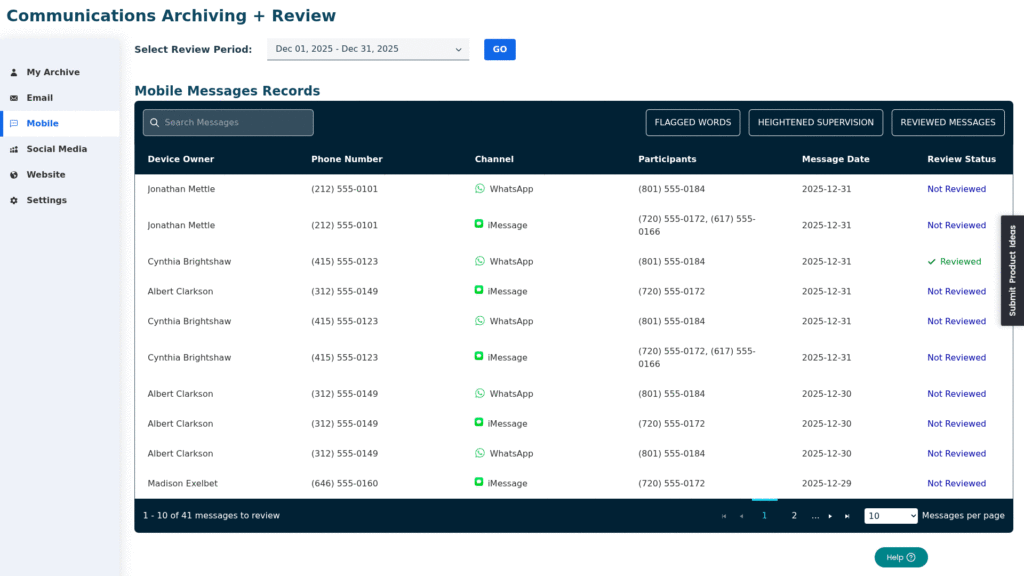
Review Built for How CCOs Actually Work
The platform gives you control over your review process:
- Determine precise sample sizes that align with your risk assessment
- Establish keywords and safe phrases that reflect your business
- Flag specific employees for heightened supervision
- Exclude certain accounts or domains from review
- Filter and retrieve archived content by channel, keyword, date range, and more
Communications review activities link directly to your compliance calendar. You maintain a centralized compliance log to track and document completed reviews, with archived data stored securely for audit preparedness. And if you need additional support, Comply’s Managed Services team can assist with communications and advertising reviews.
How This Connects to Your Broader Compliance Framework
Communications retention isn’t just about Rule 204-2. It directly supports your obligations under the Marketing Rule (206(4)-1), your supervisory requirements under Rule 206(4)-7, your annual compliance review, and your exam preparedness.
Examiners evaluate whether your policies work. Documentation of capture, review, and escalation strengthens your ability to demonstrate compliance across all of these areas.
The Standard Going Forward
Advisory communications continue to evolve across channels. Regulatory expectations have expanded to match.
Books and records requirements haven’t changed in principle – but the channels where business occurs have expanded significantly. Firms that bring text messaging and digital communications under structured, documented supervision strengthen their compliance posture, reduce recordkeeping exposure, and improve exam readiness.
Your archive should reflect the reality of how your firm operates in 2026.