 Comply Launches Financial Services' First Agentic Compliance Platform MCP Server, Enabling Teams to Build Custom AI Agents Without Developers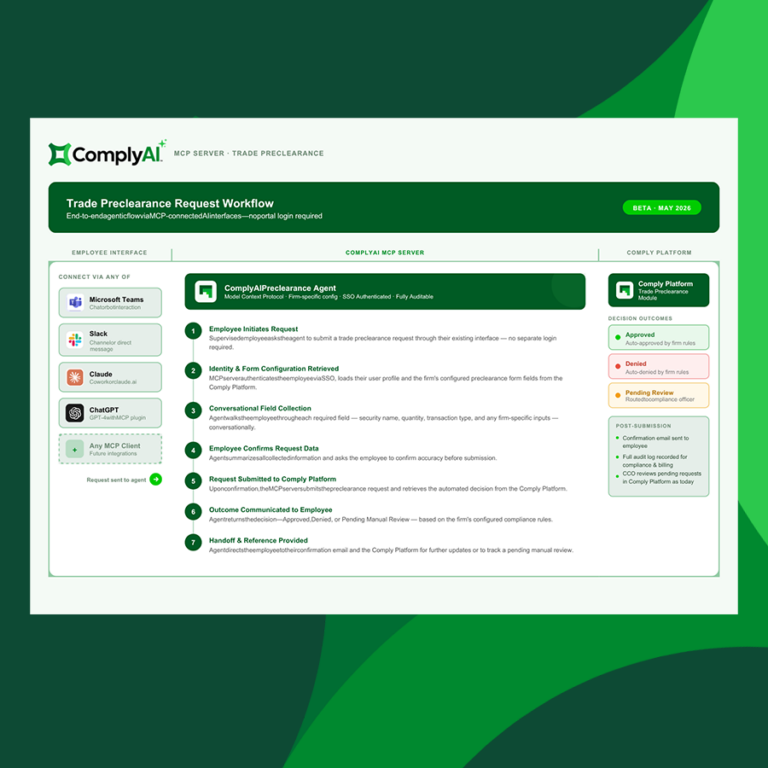
First came generative AI. Then came custom-built AI tools. Now comes Model Context Protocol or MCP servers.
For compliance teams, the question has never really been whether to use AI. It has been how to do it safely, with the right controls, and without sacrificing efficiency. MCP servers are the next step in that evolution.
Here is how they work, why they matter, and why firms with a responsibly built solution and a well-maintained compliance program will be the ones ahead of the curve.
AI Answers. An MCP Server Connects.
Most people have used an AI assistant — ChatGPT, Claude, Microsoft Copilot — to draft something, summarize something, or answer a question. That interaction is contained: you provide input, the AI responds, and nothing happens in any other system.
An MCP server bridges that gap. It is an open protocol, introduced by Anthropic in late 2024, that allows AI assistants to connect directly to external applications, retrieving information, collecting inputs, and submitting requests on behalf of the user.
A simple way to picture it: instead of an employee stopping their work to log into a separate system and fill out a form, they stay in the tool they’re already using (e.g. Teams, Slack, Claude) and the AI assistant handles the interaction with the separate system on their behalf.
An MCP server is the infrastructure that makes agentic behavior possible — but it is not itself an AI agent. Think of it as the road. What travels on it, and how autonomously, depends on how it is built and governed.
Why This Matters for Compliance in Financial Services
Financial services compliance is built on workflows that require employee participation: trade preclearance requests, policy certifications, disclosure submissions, annual acknowledgments. These workflows create the documentation that regulators expect, and that firms rely on to demonstrate their controls are working.
The problem is friction. Employees have to stop what they’re doing, switch systems, log in, navigate a form, and submit a request — often in the middle of time-sensitive work. In practice, that friction produces delays, incomplete submissions, and gaps in the audit trail.
An MCP server addresses this at the source. By connecting an AI assistant directly to the compliance platform, firms can allow supervised employees to interact with compliance workflows without leaving the tools they already use.
What Changes — and What Doesn’t
For compliance teams, the natural first question is: if the access point changes, what else changes? The answer is less than you might expect.
What changes: The channel through which a supervised employee accesses the compliance workflow. Instead of logging into a platform, they interact with an AI assistant that is connected to the platform via an MCP server. The assistant handles field collection, confirmation, submission, and status of return.
What doesn’t change: The compliance process itself. The policies, rules, and approval logic remain exactly as configured. Every request submitted through the MCP server generates the same audit log entry as a directly submitted request. Supervisors receive the same notifications, and examiners will see the same record in the audit trail.
This distinction matters. The MCP server is simply a new way of accessing the compliance system you already have.
| MCP Server | Direct Platform Login | |
| Employee experience | Stays in Teams, Slack, or AI tool | Switches to a separate system |
| Authentication | Handled automatically in the background | Separate login required |
| Field Collection | Conversational, guided by the AI agent | Manual form completion |
| Submission | Submitted to the platform via MCP | Submitted directly via the UI |
| Audit Log | Full entry generated in the platform | Full entry generated in the platform |
| Compliance rules | Evaluated by the existing rule engine | Evaluated by the existing rule engine |
| Outcome delivery | Returned in the same tool | Viewed in the platform |
| Underlying control | Unchanged | Unchanged |
The Regulatory Context
Regulators have made their expectations clear; AI is an examination priority in 2026. Both the SEC and FINRA introduced dedicated AI governance sections in their examination frameworks this year. What they are looking for is not whether firms use AI, but whether AI use is supervised, documented, and grounded in the firm’s actual controls and policies.
MCP-based compliance tools that connect to a firm’s existing compliance infrastructure are, by design, aligned with that expectation. The AI is not making compliance decisions. It is facilitating access to the system that does. The outputs are logged, the records are complete, and the governance remains with the firm.
That is a meaningful difference from deploying a general-purpose AI tool and hoping it produces defensible compliance outputs.
Why Now
The tools employees use every day are becoming AI-native at the same time. Compliance infrastructure that waits for that shift to be complete will find itself out of step with both how work happens and what regulators expect.
The firms paying attention now are asking: as our employees spend more time in AI tools, how do we ensure our compliance workflows stay connected to them? An MCP server is the answer that is beginning to emerge — and the firms that understand it now will be the ones that are ready when it matters.
The firms that understand what MCP servers are, and how to deploy them responsibly, will not be scrambling to catch up. They will already be there.
Frequently Asked Questions
What does MCP stand for?
MCP stands for Model Context Protocol. It is an open standard developed by Anthropic that allows AI assistants to connect to and interact with external applications and systems on behalf of a user.
How is an MCP server different from a traditional API?
A traditional API requires custom development for each specific integration and is designed for machine-to-machine data exchange. An MCP server is designed for AI-to-system interaction — enabling multi-step, conversational workflows that an AI agent can execute across enterprise systems without custom per-workflow development.
Is an MCP server secure for compliance use in financial services?
When purpose-built for a regulated environment, yes. A compliance-grade MCP server authenticates the user, maps them to their firm’s configuration, transmits only structured submission data to the underlying platform, and generates a full audit log entry for every interaction — identical to a directly submitted request. The conversation itself is not stored.
Does using an MCP server change our compliance program or controls?
No. The compliance rules, approval workflows, and audit trail remain exactly as configured in the underlying platform. The MCP server is a new channel for accessing those controls, not a replacement for them.
Which AI tools are compatible with an MCP server? Because MCP is an open standard, any MCP-compatible interface can connect to an MCP server. In practice, that includes the tools most employees are already using. Microsoft Teams, Slack, Claude, and ChatGPT are all MCP-compatible, and the list continues to grow as adoption of the standard expands.
What compliance workflows can an MCP server support? Any workflow that requires employee input and generates a record is a candidate. That includes trade preclearance, policy certifications, annual acknowledgments, disclosure submissions, and compliance Q&A — among others. The specific workflows available will depend on how the MCP server is built and which compliance platform it connects to.